
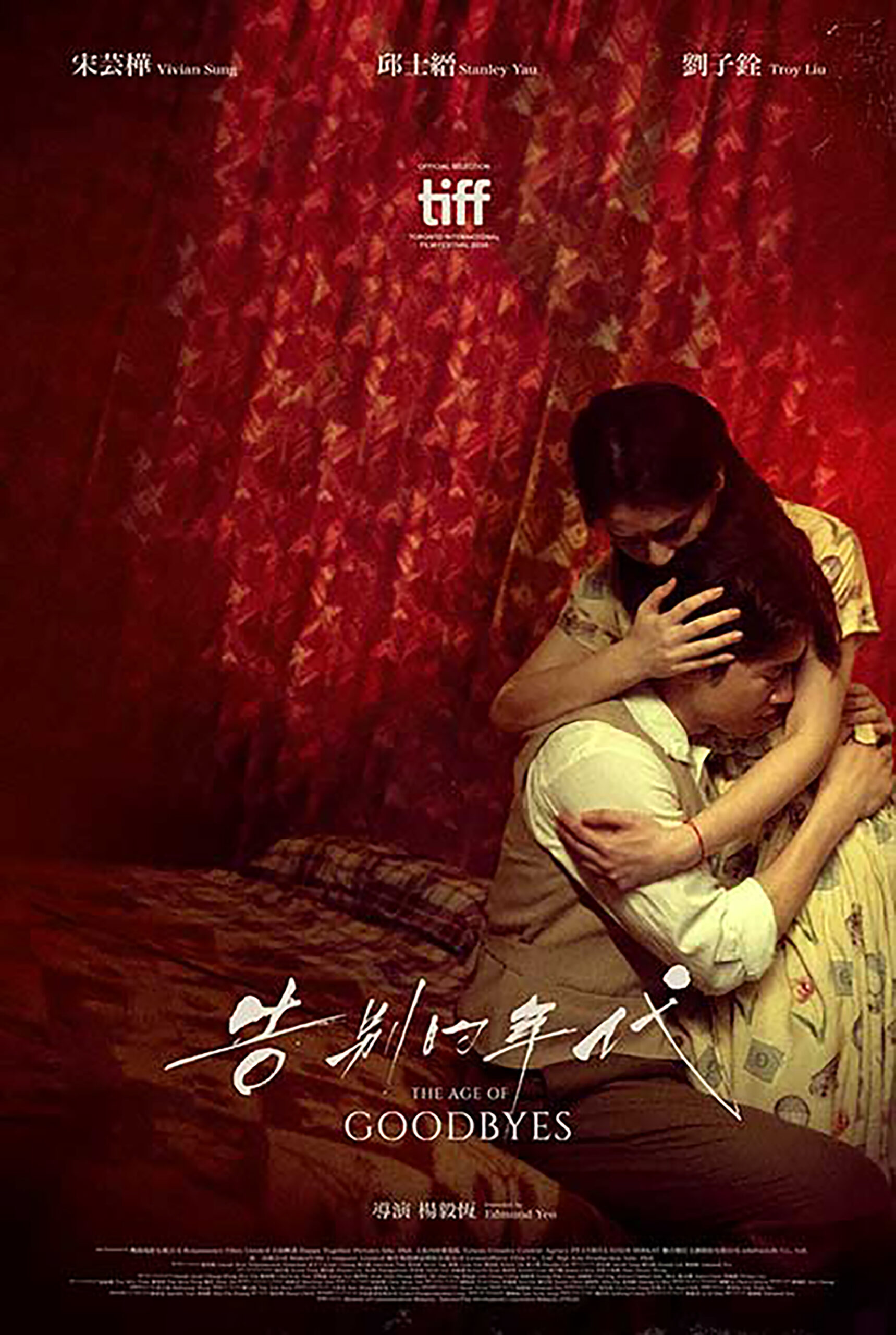
The Age of Goodbyes 告別的年代
2026 Malaysia / Taiwan – 142 min
Directed by Edmund Yeo
Screenplay | Edmund Yeo
Novel | Li Zi-Shu
Cast | Vivian Sung Yun-Hua, Stanley Yau Sze-Chun, Troy Liu Tzu Chuan, Prapamonton Eiamchan
Cinematography | Chen Chi-Wen
Editing | Edmund Yeo
Music | Tôn Thất An
Sound | Patrick Tu, Tu Duu-Chih
Producers | Dennis Lai, Edmund Yeo
World Premiere at the Toronto International Film Festival, 2026, Special Presentation
“… Ton That An’s music is another highlight. His compositions manage to capture the different eras in a subtle but definitely memorable way, supporting the emotional shifts without overwhelming them.
[…]
“The Age of Goodbyes” is a visually sumptuous and narratively ambitious adaptation that demands considerable attention from the viewer. Its convoluted structure occasionally works against its accessibility, but Yeo ultimately manages to bring its multiple timelines, love triangle, historical trauma and surreal touches together. Vivian Sung’s excellent performance, Stanley Yau’s dual role, the meticulous production values and Ton That An’s music make this an impressive work about how history becomes memory, how memory becomes story and how stories continue to shape the people who inherit them.”
Panos Kotzathanasis – Asian Movie Pulse
Listen to the score
(click image to open)
About composing the score of The Age of Goodbyes.
Tokyo 2024. It was a Saturday afternoon in January. I was sitting in a café with Edmund in the Kabukicho district. He was telling me about a new film project he had in mind—an adaptation of a highly successful novel by a Malaysian author Li Zi Shu, published a few years earlier, a story that begins during the social unrest of May 1969 in Kuala Lumpur and spans several generations, from the 1950s to the early 1990s. “Mystery, gangsters, family drama, a curse—Hitchcock meets Almodóvar, all set in 1970s Malaysia!” Edmund told me enthusiastically. Even though I didn’t yet know if the film would actually get made, ideas were already taking shape in my head!
A narrative spanning multiple generations offers great creative freedom for the music, and with a director like Edmund, I knew we were going to have a lot of fun.
One of the first ideas I had was a piece in the Baroque style—reminiscent of the concertos by Corelli or Vivaldi, or the violin sonatas by Leclair or Westhoff that I particularly loved.
While most films take years to materialise, the pre-production phase took less than a year, and filming for ‘The Age of Goodbyes’ was already underway by the spring of 2025!
The first six months of 2025 were incredibly intense for me on every level. My mother was dying, and fortunately, I was able to be by her side during her last weeks, then to support my father through his grief in the two months that followed. As for work and projects, three films—Eel, Skin of Youth, and Sammi who can detach his Body Parts—were premiering worldwide, and I was deep into composing for Erik Shirai’s documentary-fiction How to feed a hungry Ghost and a short documentary for Lee Hong Chi…
So where did The Age of Goodbyes fit into all this? I had started sending a few themes to Edmund—including one played on the erhu by Guo Gan that I had written years earlier and which had remained in limbo all that time.
The day after my mother’s funeral, I had to rush to write music for a 90s club scene that was scheduled to be filmed just a few days later…
My singing teacher, Julia Peláez, had always told me that if you were out of breath on stage, you had to incorporate that into your singing—phrase it differently—and, above all, never try to hide it or pretend you were not breathless! In music, the moment you play a note is what matters most; what follows flows from what you did at that exact instant. The key is to remain constantly in the present moment, and beautiful surprises will reveal themselves.
Amidst the storm I was weathering at the time, that is exactly what I did.
I didn’t actually begin composing for this film until the autumn of that year. In the meantime, I had managed to jolt my inspiration back to life and compose the score for Leon Le’s second film Quán Kỳ Nam (Ky Nam Inn); I had traveled to Saigon to meet Nguyễn Võ Nghiêm Minh and discuss his new film, PictureHouse, which he had just finished shooting and for which I had been invited to compose the music, and we were preparing a series of live performances featuring the score from Eel for the C-Lab Sound Festival in Taipei. Meanwhile, on the production side of The Age of Goodbyes, impatience and nervousness were beginning to unsettle the team; I could only assure them that the music would be ready in due time…
Understandably, those words didn’t reassure them at all. Yet, even though the path of intuition might seem risky and uncertain, the seventeen films I had under my belt proved that I would always eventually deliver!
Amidst this uncertainty, musical ideas would appear as points of light toward which I needed to steer. The scenes featuring Lin Sang and Mong Sang’s father and grandfather inspired me to revisit one of my early dance pieces, Nina’s Hidden Glass. In the original version, the music opens with a male choir and timpani and a soprano voice singing over them —Isabelle Thomas’ voice. I re-recorded all the vocal parts—fatigue and a few colds had added some extra low notes to my range, so I decided to take advantage of that—and then I added a string section played by Edric and Emily on violin and cello, respectively.
It was fascinating to revisit a piece of music written over twenty years ago and give it a new shape. Back then, around the same time, I had been composing for my first ballet with Jo Kanamori, NINA – materialize sacrifice and had created a variation of that choir motif where the voices began with an elegiac tone but ended in a state of possessed chaos. I reworked the first segment of that variation, recorded new vocals and rounded it all out with percussion by Allen and a few cello lines, whilst adding Isabelle’s singing. It was perfect for the scene with the mythical beast that Lin Sang and Mong Sang’s grandfather encounters in the forest. The cello theme was then turned into another piece when Lin Sang tells about the aftermaths of May 13th.
Edmund enthusiastically embraced all the music I gave him. It truly was a joyous creative process, just as it was for our first film Moonlight Shadow.
Little by little, The Age of Goodbyes was finding its shape, rythm, sonic tone and colour! During the mixing sessions at 3H studio with Tu Chun Tang, the latter declared that in this film where memory, reality, non-linear narration, the multiple timelines intertwine, the music was going to be extremely important, like a narrator beyond the image.
The characters, and their environment, each have a theme, sometimes several. For the complex relationship between Du Li An and Lin Sang/Mong Sang, it is the Baroque piece. Initially, I had planned to play the continuo on the harpsichord but my intuition compelled me to use a guzheng instead. Keith Lee acquitted himself of this task admirably, even if he cursed me more than once because the guzheng is tuned according to the pentatonic scale while the chords he had to play were written according to the oh-so-chromatic Western scale!
The day I had scribbled the music down on paper, Edmund was in Taipei, so I told him to drop by so I could play it for him on the piano. His immediate enthusiasm reassured me, even though I repeatedly told him that the whole thing would be played by other instruments.
“This music will be at the heart of the film, at the moment when Du Li An and Mong Sang go to the lake, and we see Kei and Mana looking at them as they come from another temporal dimension!” he said.
A day or two later I told Edmund to come to my house again because I was going to record the cello parts with Emily. Emily and I rehearsed this Du Li An piece a few times before he arrived. The cello line is singing above the violin part that Edric was to play days later. I was inspired by the operas of Handel and Caldara, which are full of sublime slow arias.
Edmund was over the moon. And so was I! We were like two children playing at building an invisible world of our own.
There is also this cha cha number for the wedding of Du Li An and her gangster husband. Of course, I thought of Grace Chang but it was also a nod to Bruce Lee who, before exploding as an international star, was an excellent cha cha dancer. As the film’s budget was not high, this wedding scene was filmed with few extras. But once the cha cha piece came into the picture with the two guzheng played by Keith, it felt like an opulent wedding!
I attentively listened to piano parts in Tito Puente’s music so to channel the way it was arranged, with the bongos and the cowbells! It was fun and Edmund couldn’t stop listening to it!
The character of teenager Kei is the richest musically, and I was able to give free rein to my inspiration, between contemplative pieces with solo cello and string ensemble when he goes to the cave, more intimate (piano and light percussion) for his relationship with Mana, or the clubby music for the boys on their night out.
Lau Lin was treated to an instrumental version of a soulful vocalise that I had written in the last century for Portuguese singer Bévinda – and also for Allex. This vocalise appeared in our collaborative album project ‘Fukaeri’, in a vocal version. Here in the film, it was Emily who played both parts, and did so magnificently.
I believe ‘The Age of Goodbyes’ is more lyrical and contains more melodies than any other film I have composed for.
The stylistic variety of the different pieces is justified by the multiple temporal lines, however, the themes respond from one period to another, are assembled or deconstructed, taken up or played as an echo by other instruments.
But surprisingly, all this music coexists very naturally and cohesively in the film. Thanks to Edmond’s vision, to the mixing work with Chun Tang… Perhaps also because the music is directly connected to my own life experience, that several pieces come from different periods of my life, and that this fits with the way the film is structured.
Being in the present moment allows you to be in any other dimensions!


